What is a training needs analysis?
Training needs analysis (TNA) is a process to identify the gap between the actual and the desired knowledge, skills, and abilities (KSAs) in a job.
The need for such analysis usually arises due to an organizational problem. It can be a lower-than-expected quarter for the sales team, changing technology threatening to impact the continuity of train operators, or constantly low customer satisfaction scores forcing the product team to be more agile and customer-focused. In all these instances, the problems can potentially be resolved through training.
In other words, when a lack of knowledge, skills, or abilities causes the problem, conducting a training needs analysis and subsequent training can be a viable solution.
Conversely, training needs analysis won’t be effective if it’s broader organizational issues that cause the problems. This may mean that instead of a lack of knowledge, skills, or abilities, our diagnosis may point out that sales are low because of a mismatch between the work and the rewards. Or that customer satisfaction is low because the top-down driven product strategy is not in line with what customers are looking for.
These problems cannot be solved through training (alone) but require organizational interventions.
Knowledge, Skills, and Abilities
KSA refer to the knowledge, skills, and abilities that an employee must have to perform their responsibilities within their roles. They’re listed in the job description and guide candidates and employers to assess the person’s chance to succeed.
Knowledge
Topics and subjects that can be used when performing work functions when the person is hired.
Examples:
- Knowledge of accounting principles and practices
- Knowledge of budget control policies and procedures
Skills
Technical or manual proficiencies are usually gained or learned through training. They are observable and measurable.
Examples:
- Skills in analysis and problem-solving
- Skills in using Microsoft Excel and accounting software
Abilities
Capacity to apply knowledge and skills to perform a task. It also includes personal and social traits which are innate or acquired without formal training.
Examples:
- Ability to process large amounts of numerical data
- Ability to prioritize work and meet deadlines
How to conduct a training needs analysis
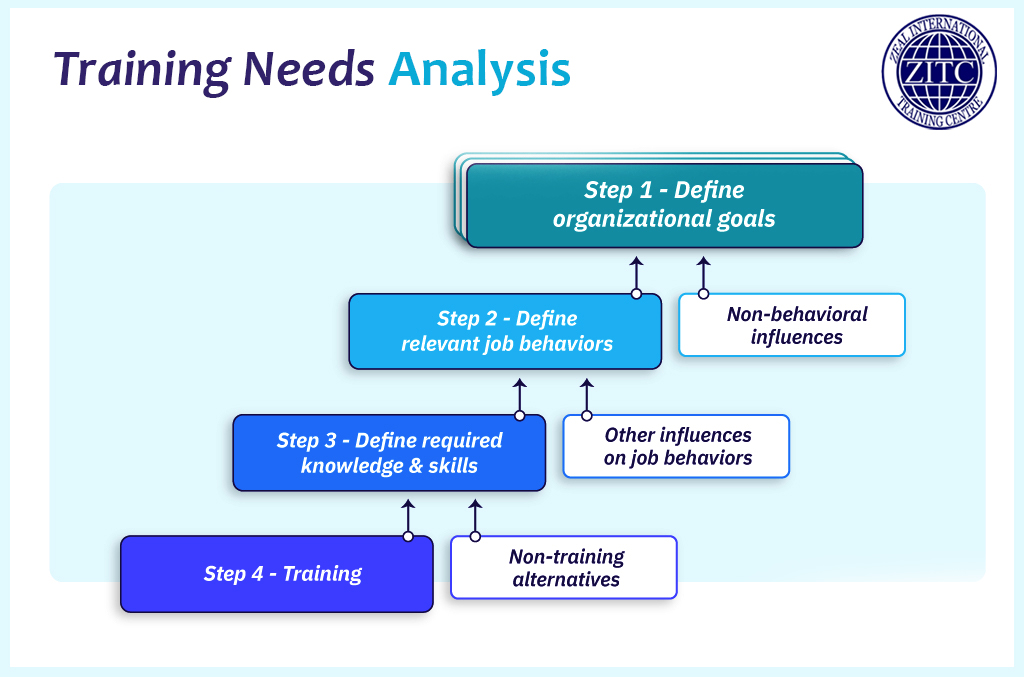
When conducting a training needs analysis, it is good practice to follow a standardized process.
We will go through each of the training needs analysis process steps using an example, explain the different elements to account for, and define what is needed to move forward to the next step. In our example, we will assume that a training solution can fulfill an organizational need.